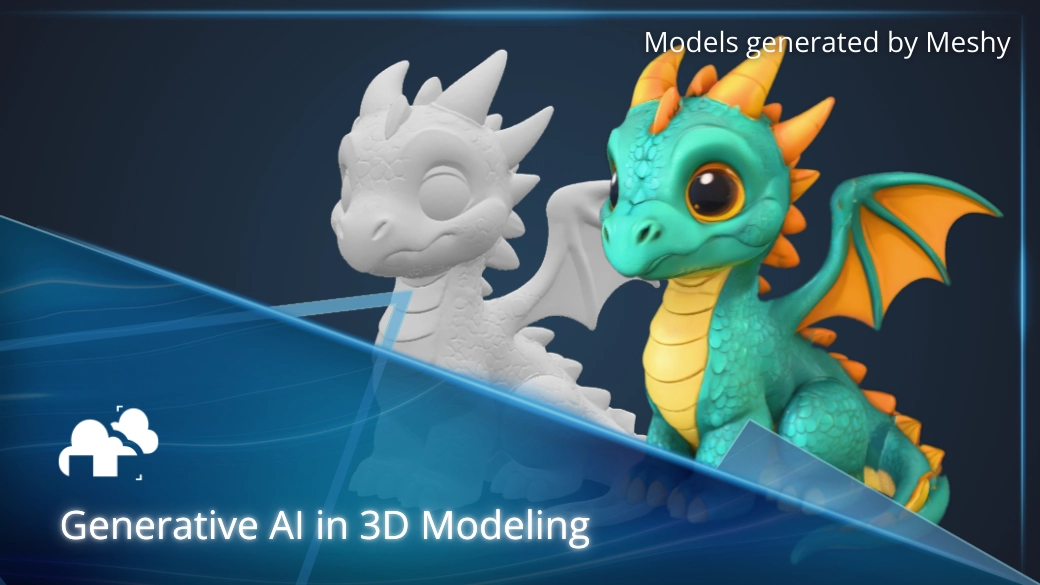
The 3D Creation Revolution: Exploring Generative AI Tools
In the dynamic world of digital design, a paradigm shift is underway, propelled by the relentless march of artificial intelligence. We are witnessing nothing less than a revolution in how 3D content is created, thanks to the emergence of advanced generative AI for 3D modeling. This technology is not merely automating tasks; it's actively participating in the creation process, turning abstract ideas into tangible three-dimensional assets with unprecedented speed and efficiency. From indie game developers to architectural firms and Hollywood studios, the impact of generative AI is reshaping workflows and expanding creative horizons.
For decades, 3D modeling has been a highly specialized, labor-intensive craft, demanding years of training and meticulous attention to detail. Artists painstakingly sculpt vertices, edges, and faces to build virtual worlds. While the human touch remains invaluable, generative AI tools are now stepping in to assist, accelerate, and even originate complex 3D forms, textures, and environments. This article delves into the core of this transformation, exploring what generative AI for 3D modeling entails, its myriad benefits, the leading approaches being developed, and the challenges and exciting future it presents for creators worldwide.
What is Generative AI for 3D Modeling?
At its heart, generative AI for 3D modeling refers to artificial intelligence systems capable of producing novel 3D content. Unlike traditional modeling software, where humans directly manipulate geometric primitives, generative AI models learn from vast datasets of existing 3D objects, images, or text descriptions. Based on this learning, they can then generate new 3D models, textures, or even entire scenes, often with minimal input from a user.
The methodologies employed by generative AI in 3D are diverse and constantly evolving:
- Text-to-3D Generation: Perhaps the most fascinating approach, this allows users to input a natural language description (e.g., "a futuristic sports car with glowing blue accents") and have the AI generate a corresponding 3D model. While still in its infancy regarding intricate details and perfect fidelity, this capability promises to democratize 3D creation by making it accessible to anyone who can describe an object.
- Image-to-3D Reconstruction: This involves creating a 3D model or scene from one or more 2D images. Techniques like Neural Radiance Fields (NeRFs) and Gaussian Splatting analyze a collection of photographs taken from different angles to reconstruct a highly photorealistic 3D representation, complete with lighting and volumetric data.
- AI-Assisted Procedural Generation: Building upon existing procedural generation techniques, AI can guide algorithms to create complex environments, architectural structures, or organic forms. Instead of manually tweaking parameters, designers can use AI to intelligently iterate and optimize generated content based on specific criteria or styles.
- Style Transfer and Variation: AI can analyze the artistic style of one 3D model or a set of textures and apply that style to another, or generate numerous stylistic variations of an existing asset. This is particularly useful for populating game worlds or creating diverse product lines.
It's crucial to understand that these tools aren't just automating pre-defined tasks; they are generating unique outputs, often surprising even their developers. This makes generative AI for 3D modeling a powerful ally for creative exploration.
Unlocking New Dimensions: Benefits and Applications of Generative AI in 3D
The implications of generative AI for 3D modeling are profound, offering a host of benefits that can transform creative workflows across industries. This technology is not just about doing things faster; it's about doing things differently, enabling previously unimaginable levels of creation and iteration.
Key Benefits:
- Accelerated Prototyping and Iteration: Designers can rapidly generate multiple design concepts for products, characters, or environments in minutes rather than hours or days. This drastically shortens the feedback loop and allows for more extensive exploration.
- Democratization of Design: By simplifying the complex process of 3D creation, generative AI lowers the barrier to entry, allowing individuals without extensive modeling experience to bring their ideas to life.
- Complexity and Detail: AI can handle the generation of highly intricate geometries and organic forms that would be exceedingly time-consuming or even impossible for a human to model manually. Think of highly detailed natural landscapes, complex mechanical parts, or elaborate architectural flourishes.
- Creative Exploration and Inspiration: Generative AI can act as a powerful brainstorming partner, suggesting novel designs or unexpected variations that can spark new creative directions, helping artists overcome creative blocks. For more on this, check out our article on Unlocking Creativity: Generative AI in 3D Design.
- Cost Efficiency: By reducing the time and specialized labor required for 3D asset creation, businesses can significantly cut production costs.
Diverse Applications Across Industries:
- Game Development: Automatically generate environmental assets (trees, rocks, buildings), populate large open worlds, create character variations, or even design levels. This frees up artists to focus on hero assets and core gameplay experiences.
- Architecture and Interior Design: Rapidly generate different floor plans, furniture layouts, or interior decor options based on specific parameters and aesthetic preferences. Visualize complex structures with ease.
- Product Design and Manufacturing: Create numerous conceptual designs for new products, iterate on ergonomic shapes, or design custom parts for 3D printing, speeding up the entire product development cycle.
- Film, Animation, and VFX: Generate background elements, crowd simulations, realistic digital doubles, or intricate destruction effects, greatly enhancing production value while managing budgets.
- E-commerce and Marketing: Generate high-quality 3D models of products for virtual try-on, augmented reality experiences, or interactive online catalogs, enhancing customer engagement.
Navigating the Toolkit: Leading Generative AI Approaches for 3D Artists
While the field is evolving rapidly, several key approaches and tool categories stand out in the realm of generative AI for 3D modeling. Understanding these will help artists and designers leverage this technology effectively.
Current Approaches and Tools:
- Text-to-3D Platforms: A significant area of focus, these platforms allow users to simply type a description and receive a 3D model. Early examples might produce simple shapes, but more advanced systems are capable of generating textured, complex objects. Challenges often lie in achieving precise control over artistic style, specific geometries, and clean mesh topology.
- AI-Powered Texture and Material Generators: These tools are already highly functional. They can generate realistic, tileable textures from text prompts (e.g., "mossy cobblestone path," "rusty metallic surface") or enhance existing 2D images into PBR (Physically Based Rendering) materials. This significantly reduces the time spent on UV mapping and texturing.
- Neural Radiance Fields (NeRFs) and Gaussian Splatting: While not generative in the traditional "from scratch" sense for new objects, these methods use AI to create stunningly realistic 3D scene representations from a series of 2D photographs. They are excellent for recreating real-world environments with accurate lighting and reflections, offering a new way to capture and integrate complex reality into virtual spaces.
- AI-Assisted Meshing and Optimization: Beyond generation, AI can optimize existing 3D models by reducing polygon counts while maintaining visual fidelity, automatically generating LODs (Levels of Detail), or even intelligently retopologizing meshes for animation readiness. This is crucial for performance in real-time applications like games.
- Generative Design Plugins: Many traditional CAD and 3D software packages are starting to integrate AI-powered generative design features. These plugins can suggest optimized structural forms based on load requirements or create organic shapes that meet specific functional criteria, often seen in engineering and industrial design.
Practical Tip: When experimenting with these tools, remember that generative AI is an assistant, not a replacement for your artistic eye. The best results often come from a hybrid workflow where AI generates initial concepts or variations, and a human artist refines, curates, and integrates them into a cohesive vision. Start with simple prompts and gradually add complexity as you learn how the AI interprets your input.
The Road Ahead: Challenges and the Evolving Landscape of Generative AI for 3D Modeling
While the potential of generative AI for 3D modeling is immense, the journey is not without its hurdles. Understanding these challenges is key to anticipating the future direction of this transformative technology.
Current Challenges:
- Fidelity and Control: Achieving precise artistic control over generated models, ensuring they perfectly align with a specific vision or existing aesthetic, remains a significant challenge. AI-generated models can sometimes lack the 'soul' or subtle nuances a human artist imbues.
- Mesh Topology and Rigging: AI-generated meshes can often be messy, with irregular topology that makes them difficult to edit, UV map, or rig for animation. Significant manual cleanup is often required.
- Computational Resources: Training and running advanced generative AI models for 3D content can be incredibly demanding on computational resources, requiring powerful GPUs and significant energy.
- Ethical and Legal Concerns: Questions around data provenance, copyright of generated assets, potential for misuse (e.g., deepfakes), and algorithmic bias are complex and require careful consideration as the technology matures.
- Integration into Workflows: Seamlessly integrating these new AI tools into existing professional 3D pipelines, which often involve multiple software packages and team members, is an ongoing process.
The Future Landscape:
Despite these challenges, the trajectory for generative AI for 3D modeling is unequivocally upward. We can expect several key developments:
- Hybrid Workflows will Dominate: The future isn't AI replacing human artists, but rather an intelligent collaboration. Artists will become curators, editors, and directors of AI, focusing on high-level creative decisions while AI handles the grunt work and iterative tasks.
- Enhanced Control and Customization: Future tools will offer much finer-grained control, allowing artists to guide the AI more precisely, specify aesthetic parameters, and easily refine generated outputs to meet exact specifications.
- Specialized AI Models: We'll likely see highly specialized AI models trained for specific tasks (e.g., organic sculpting, hard-surface modeling, architectural elements) rather than general-purpose 3D generators.
- Real-Time Generation and Interactivity: The ability to generate and modify 3D content in real-time, perhaps even within a game engine or a VR environment, will open up entirely new creative possibilities.
- Cross-Modal Generation: Improved AI that can seamlessly translate between text, 2D images, sound, and 3D models will lead to more intuitive and powerful creative tools.
The convergence of human ingenuity and artificial intelligence promises to redefine the very act of creation. As we navigate this exciting new era, the discussion on Future of Design: AI's Impact on 3D Modeling becomes even more relevant.
The revolution spearheaded by generative AI for 3D modeling is not a distant sci-fi fantasy; it's happening now. It's empowering artists, democratizing design, and pushing the boundaries of what's possible in virtual worlds. While challenges remain, the potential benefits for efficiency, creativity, and innovation are undeniable. Embracing these tools, learning their nuances, and integrating them thoughtfully into creative processes will be crucial for anyone looking to stay at the forefront of the digital design landscape. The future of 3D creation is dynamic, collaborative, and undeniably intelligent.