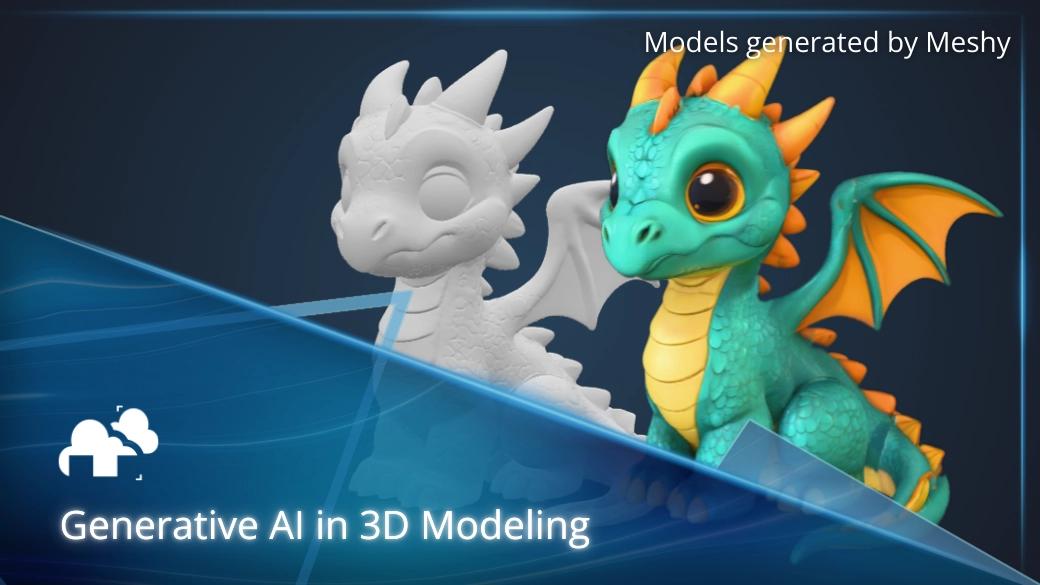
Unlocking Creativity: Generative AI in 3D Design
The world of 3D design is undergoing a profound transformation, driven by advancements in artificial intelligence. What was once a labor-intensive, time-consuming process is now being supercharged by algorithms capable of generating complex, innovative designs with unprecedented speed and efficiency. At the forefront of this revolution is generative AI for 3D modeling, a technology that promises to redefine how designers conceptualize, create, and iterate their visions. No longer limited to merely assisting human input, AI is now actively participating in the creative act, opening up a universe of possibilities previously unimaginable.
This paradigm shift is not just about automation; it's about augmentation. Generative AI tools empower designers to explore a much wider design space, discover optimal solutions, and bring ideas to life with a fluidity that manual methods simply can't match. From architecture to product development, game design to medical imaging, the impact of AI-driven 3D modeling is expanding rapidly, promising a future where creativity is amplified, not replaced.
What is Generative AI in 3D Design?
At its core, generative AI in 3D design refers to the use of artificial intelligence algorithms to automatically produce novel 3D models, textures, or even animations based on a set of parameters, constraints, or learned data. Unlike traditional 3D modeling software, where a designer meticulously sculpts or draws every polygon, generative AI can take high-level instructions—whether text prompts, sketches, or desired performance criteria—and synthesize complete 3D assets.
The magic behind this capability often lies in advanced machine learning techniques such as Generative Adversarial Networks (GANs), variational autoencoders (VAEs), and more recently, diffusion models. These networks are trained on vast datasets of existing 3D models, learning the underlying patterns, structures, and aesthetics. Once trained, they can then generate entirely new data that mimics the characteristics of their training set, but with unique variations. For example, an AI trained on architectural blueprints could generate thousands of unique building designs, each adhering to specified structural and aesthetic rules. This ability to create from "nothing" (or rather, from learned principles) is what makes generative AI for 3D modeling such a game-changer.
The Transformative Power of Generative AI for 3D Modeling
The implications of this technology for the design industry are immense. Generative AI doesn't just make existing processes faster; it enables entirely new workflows and creative avenues:
- Accelerated Concept Generation: Designers can rapidly iterate through hundreds or even thousands of design variations in minutes, drastically reducing the time spent on initial ideation and prototyping. This allows for more thorough exploration of the design space and quicker refinement.
- Optimization for Performance and Manufacturability: AI can analyze designs against specific criteria, such as structural integrity, material usage, aerodynamics, or ease of manufacturing. It can then generate optimized forms, like those seen in topology optimization, that are lighter, stronger, or more efficient than human-designed counterparts.
- Overcoming Creative Blocks: When human designers hit a wall, generative AI can provide a fresh perspective, suggesting unexpected shapes, patterns, or combinations that might spark new ideas. It acts as a tireless brainstorming partner.
- Mass Customization and Personalization: For industries requiring bespoke items, such as jewelry, fashion, or even medical prosthetics, AI can generate unique 3D models tailored to individual preferences or anatomical data, scaling personalization to an unprecedented degree.
- Enhanced Accessibility: By simplifying the 3D creation process through intuitive interfaces and text-to-3D capabilities, generative AI can lower the barrier to entry for non-experts, democratizing 3D content creation.
- Procedural World Building: In gaming and virtual reality, AI can generate entire landscapes, cities, or intricate environmental assets, saving immense development time and enabling richer, more dynamic virtual worlds.
Practical Applications and Use Cases Across Industries
The versatility of generative AI for 3D modeling means its applications are rapidly expanding across a multitude of sectors:
- Architecture and Construction: From generating entire building layouts based on site constraints and sustainability goals to designing complex parametric facades, AI is revolutionizing architectural design. It enables architects to explore forms that are not only aesthetically pleasing but also structurally sound and energy-efficient.
- Product Design and Engineering: Manufacturers are using generative AI to design optimized components for everything from aerospace parts to consumer electronics. The AI can suggest forms that minimize material waste, improve performance, or simplify assembly, leading to more sustainable and cost-effective products.
- Game Development and Entertainment: The creation of realistic 3D assets and environments is a cornerstone of modern gaming. Generative AI can automate the creation of props, characters, textures, and even entire game levels, freeing artists to focus on narrative and unique elements. Imagine an AI generating countless unique flora and fauna for a fantastical world! For a deeper dive into how AI is changing the landscape of digital creation, you might find D Creation Revolution: Exploring Generative AI Tools particularly insightful.
- Fashion and Jewelry Design: AI can generate unique patterns for fabrics, design intricate jewelry pieces based on material properties and desired aesthetics, and even create virtual try-on experiences, leading to highly personalized and innovative products.
- Medical and Scientific Visualization: Generating accurate anatomical models from medical scans, designing custom prosthetics, or visualizing complex molecular structures can all be enhanced by generative AI, aiding in research, education, and patient care.
Navigating the Future: Tips for Designers and Businesses
As generative AI for 3D modeling continues to evolve at a breathtaking pace, designers and businesses must adapt to harness its full potential. Here are some actionable tips for staying ahead:
- Embrace Learning and Experimentation: Don't wait for AI to become ubiquitous. Start exploring existing AI-powered 3D tools and plugins. Experiment with different prompts and parameters to understand their capabilities and limitations. Learning new skills in prompt engineering and AI model customization will be invaluable.
- Focus on Curation and Refinement: Generative AI excels at creating variations, but human expertise is crucial for selecting the best outputs and refining them to meet specific artistic or functional goals. The designer's role shifts from manual creation to guiding, curating, and enhancing AI-generated content.
- Understand the Ethics and Ownership: As AI generates content, questions around intellectual property, bias in training data, and responsible use become paramount. Stay informed about best practices and emerging legal frameworks related to AI-generated assets.
- Integrate AI into Existing Workflows: Look for opportunities to seamlessly integrate generative AI into your current design pipeline. It might be used for initial concept generation, texture creation, or optimizing specific components, rather than replacing the entire workflow overnight.
- Collaborate with AI: Think of AI not as a competitor but as a powerful collaborator. Use it to offload repetitive tasks, generate diverse ideas, and explore possibilities that might be too time-consuming to consider manually. For a broader perspective on the future design landscape, consider reading Future of Design: AI's Impact on 3D Modeling.
- Stay Updated with Research: The field of generative AI is moving incredibly fast. Follow key research papers, industry news, and software updates to understand new capabilities and how they might impact your work.
The advent of generative AI for 3D modeling marks a pivotal moment in the history of design. It's not just a technological upgrade; it's a fundamental shift in the creative process itself. By empowering designers with unprecedented tools for ideation, optimization, and iteration, AI is set to unlock new levels of creativity and efficiency across virtually every industry that relies on 3D assets. Embracing this technology will be key for individuals and organizations looking to stay competitive and innovative in the evolving digital landscape.